
Many small business owners and other work professionals are confused about the operating system (OS) and computer brand. They often raise questions like Is Mac or Windows better for small businesses.
In fact, it’s a long-running debate.
We will discuss this in two parts: one comprises data from research conducted through discussions with employees, small business owners, and work professionals. The other part is our perspective as business professionals.
All of this will help you understand which operating system you should choose for your business, or, at the very least, the significance you should give to this matter.
While buying a laptop, here is something that confuses.
If you haven’t used a Mac before, you might assume that those who use them have a business edge. However, if you’ve been exposed to the company culture, the results may surprise you.
Small businesses account for 34.8 million companies in the US in 2025, which is 99.9% of all businesses and nearly half of private-sector employment. Each company has unique technological and digital needs for its business.
You’ll find that most small businesses use Windows computers. In fact, it’s a mix of both, but the operating system or brand (among the top 6) doesn’t add much value.
In some cases, when you want to make an impression, Apple machines are undoubtedly helpful. Secondly, you can also prefer Macs in graphics-related tasks due to their incredible graphics capabilities.
Computer purchases are indeed considered for years; research indicates that business professionals, on average, don’t replace their computers for 6.069 years.
Making the right decision on such long-lasting purchases is crucial. However, when it comes to business use, this discussion is not as critical as many other factors, such as specifications.
For instance, using any cloud service doesn’t require you to inquire about your OS or brand. Zoho Workplace or Salesforce, for example, wouldn’t care about your machine; they only need it to be compatible, and both are compatible with almost all software.
The second point to consider is looking at this data. This research, in which thousands of business professionals contributed, revealed that 69% of business professionals use the Windows operating system, while 18.95% use Mac OS.
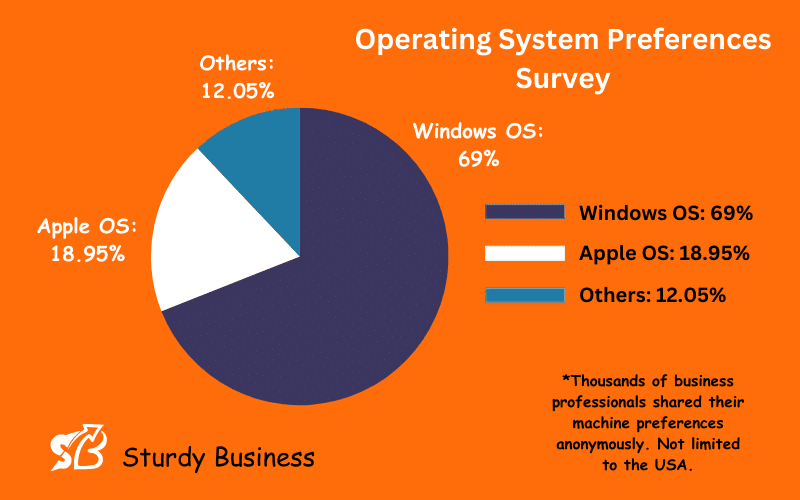
Still, there are a couple of things that might influence your purchase. So you can learn and decide whether your small business needs a Mac or Windows PC.
Before we go into the long debate, here is a quick comparison of why Windows or Mac computers make a difference.
On this page
A quick comparison
Reasons to choose an Apple computer
- Apple products are popular for their sleek design and user-friendly interface.
- Mac OS is more secure than Windows. So you face fewer security issues.
- Apple machines are popular in creative industries like graphic design, video editing, and audio.
- If your small business deals with visuals or sound engineering or something like that, then Mac can be an even better choice.
Reasons to choose a Windows computer
- Windows PCs take the edge of being cost-effective.
- Windows computers are widely used in the business world. It means you have more software and hardware options available.
- Windows machines offer more customization options.
- The hardware is easily upgradable.
- Windows OS is compatible with a wider range of peripherals and accessories.
Comparison of Mac and Windows PC for business use
As the primary goal is business, we will see how iMacs or MacBooks are different from other Windows computers and which features can influence your business.
According to SME IT trends report usage of macOS devices in small and medium-sized enterprises is on the rise while the usage of Windows devices has decreased: Windows devices comprise 56% (down from 63% in quarter three of 2024), macOS 27% (up from 24% in Q3 2024), and Linux 20% (up from 18% in Q3 2024).
Design and display
The attraction of Mac computers is not due to their high price tag but their sleek design, high-quality display, and user-friendly interface.
This is the only area where Apple has no alternative.
Some expensive Microsoft Surface laptops come with high-quality displays, but Apple products’ displays, design, and hardware are still superior to most PCs.
I believe that creative professionals, managers, and CEOs who require portable machines for attending business meetings and representing their companies should opt for Macs.
When surveyed about the most difficult things to manage as an IT admin, the top response was Windows and other Microsoft devices at 23%, followed by cloud infrastructure at 22%, macOS and other Apple devices and apps at 19%.
Otherwise, there are many other great options to buy for routine and technical work. You can buy more RAM, storage, and advanced processors at affordable prices.
For instance, in these best computers for business owners, most of the machines are non-Apple because you get high specs (that affect your work the most) at the same price.
Reliability
Macs and other popular brands like HP, Dell, and ASUS are all reliable computers.
We have used all of them for years, and if you get your machines serviced occasionally, all devices work perfectly for almost a decade.
Although PCs are easily upgradeable, they are less likely to become obsolete than Macs.
Upgradability
Upgradability is worth considering in business.
As your business grows, you might have to handle heavy tasks, and you might need to upgrade your machines.
Usually, Windows computers are easier to upgrade. However, there are certain limitations to using Windows OS if you have a Windows 10 and an older machine that is incompatible with Windows 11.
About 35% of US SMBs had no plan to upgrade ahead of Windows 10’s October 2025 end-of-support deadline. This could be a huge disadvantage to using the Windows OS.
A report by TechRadar highlighted that in the US (and globally), several firms have reported Windows 11 upgradation to be expensive and a hassle: 62% of devices require replacement or upgrades for compatibility; firms cite software compatibility issues (~47%) and productivity loss during downtime (~45%) as added costs.
Security
Security is the next significant factor that matters a lot in business.
Typically, Macs are considered more secure than Windows laptops and desktops.
Mac users are less likely than Windows users to use antivirus software (around 34% for Mac users vs. over 50% for Windows users). Mac users are also significantly less likely than Windows users to use anti-spyware software (around 10% for Mac users vs. 20% for Windows users).
Macs have built-in antivirus software to protect your machines from malware and attacks.
Secondly, as they support fewer software on macOS, it also protects your machine from attackers.
Well, it doesn’t mean that Windows PCs are unsafe. Windows 10 and 11 also have security features that protect your machine from undesired attacks.
You can also use antivirus software to add a layer of protection.
Compatibility
Usually, all the apps you use are compatible with Macs and Windows. If an app is incompatible with Mac, you have an alternative.
So compatibility is not an issue in any case.
Secondly, as most businesses use cloud services, connectivity and networking are also out of the question.
It’s obvious that no matter which computer the team operates on, you can join your team with any operating system.
You can also install macOS on your Windows PC and Windows OS on your Mac. So compatibility won’t affect your choice for routine business tasks.
Although Mac computers support most cloud-based tools like Slack and Zoom, there are certain business-critical applications, such as Microsoft Access, Power BI Desktop, and Sage 5, that either do not run on Macs or have limited functionality.
Also, Macs don’t support the Linux OS. If your small business uses Linux, you should prefer a PC because you will get various options in that market.
Affordability
It’s a no-brainer that Macs are more expensive than Windows PCs. You get tons of cheaper options for the same specs in Windows.
The price for Mac PCs/Desktops typically ranges from US$600 to US$7,000, depending on model, whereas for Windows machines, the range is broader: desktops $500-$3,000 for PCs; laptops from about $300 to $5,000, depending on specs.
For instance, if you were looking for laptops for Zoom meetings, you need to fulfill the minimum requirements for Zoom to use all the Zoom features; additionally, you need a good camera.
If you browse the web, you will get much cheaper Windows laptops for the same features as a MacBook.
Final verdict:
There is nothing wrong with using a Mac or PC for all your business. The brand and operating system are personal choices. Brands and operating systems don’t affect your business.
In fact, specs affect your business; you should focus on specs rather than thinking about brand and OS.
However, the National Bureau of Economic Research has found that Apple products are considered a status symbol, so you should prefer buying Apple products for CEOs or other team managers who have to attend meetings with other companies.
Otherwise, there are many best laptops for business owners with outstanding features. You can pick any for your business.
Do businesses use Mac or PC?
PCs are widely used in businesses. However, businesses use Macs and PCs depending on the employees’ comfort.
Most companies make it optional for employees to choose between a Mac and a PC.
Is Mac or PC better for small business?
Mac and PC are equally good for routine office work and technical jobs. However, the specs of your computer will affect your business.
You should always buy a computer with high specs for your demanding tasks.